
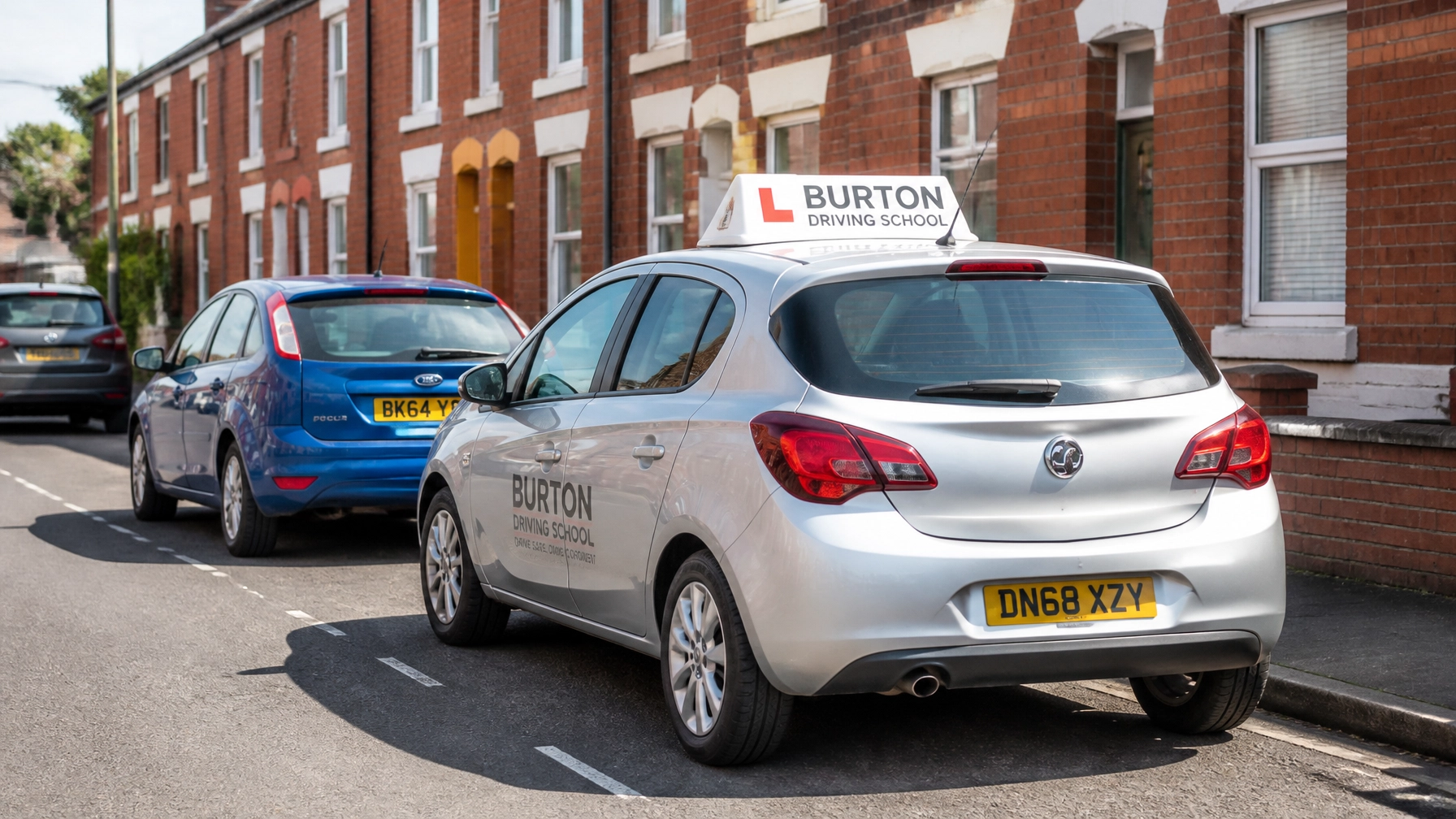
Does the very thought of parallel parking make your palms a bit sweaty? If you’ve ever found yourself circling the block five times just to find a "drive-in" space because the idea of reversing between two cars feels like a high-stakes puzzle, you are definitely not alone! At Burton Driving School, we hear this from our learners all the time. It’s one of those manoeuvres that feels like magic when it goes right but like a total mystery when it doesn't.
But here’s a little secret from the best driving schools in Burton on Trent: parallel parking isn't about luck or "having a feel for it." It’s actually just a simple recipe. Once you know the ingredients and the steps, you’ll be popping into those tight spaces outside the shops on Station Street or the residential roads near the Queen's Hospital with total confidence.
Whether you are taking driving lessons in Burton on Trent for the first time or you’re a qualified driver looking to sharpen your skills, this guide will break down the parallel park into bite-sized, stress-free steps. Let’s get you parking like a pro!
How-To Summary: Parallel Parking in Simple Steps
If you want the quick version first, here’s a simple how-to summary you can remember on lesson day or test day:
- Pull up alongside the parked car with roughly half a metre of space.
- Line up the rear of your car with the rear of the car you are parking behind.
- Check all around including mirrors, blind spots, and through the rear window.
- Reverse slowly and turn the wheel one full turn to the left once your car clears the back of theirs.
- Keep reversing at walking pace until the angle looks right and the kerb starts to disappear in your left mirror.
- Turn the wheel two full turns to the right to guide the front of the car into the space.
- Straighten up with one full turn to the left as the car becomes parallel with the kerb.
- Finish close and parallel to the kerb, then secure the car safely.
Top tip: Slow, steady movement and constant observation matter more than doing it quickly. That’s exactly what examiners want to see during driving lessons burton on Trent and on the practical test.
Why is Parallel Parking So Intimidating?
Most of the fear around parallel parking comes from two things: the fear of hitting another car and the pressure of people watching. In a busy town like Burton, it can feel like the whole world is waiting for you to finish.
The good news? On your driving test, the examiner isn't looking for "fast." They are looking for control, safety, and accuracy. If you take your time, keep the car moving at a snail’s pace, and look around like a hawk, you’re already halfway to a pass. Our instructors, who specialize in nervous driving lessons in Burton, always say: "Slow car, fast hands."
Step 1: The Set-Up (The Secret Sauce)
The most common mistake people make happens before they even start reversing. If your starting position is off, the rest of the park will be a struggle.

- Find your target: Look for a gap that is about one and a half times the length of your car.
- Signal your intent: Let people behind you know what you’re doing. Use your left indicator early so they don't crawl up your exhaust pipe!
- The "Parallel" Position: Pull up alongside the car you want to park behind. You want to be roughly half a metre (about a car door’s width) away from them.
- The Alignment: Line the back of your car up with the back of theirs. A good tip is to line up your wing mirror with their front door pillar, or simply make sure the "tails" of the cars are roughly level.
Pro Tips for Easier Parallel Parking
- Take your time setting up. A good starting position makes the whole manoeuvre easier.
- Keep the car moving very slowly. Tiny movements give you more time to steer and observe.
- Use clear reference points. The same routine helps build confidence during driving lessons burton upon Trent.
- Do not panic if it goes slightly wrong. As long as it is safe, you can correct your position.
- If you're in a manual car and feeling overloaded, consider automatic lessons. Our automatic driving lessons in Burton can help you focus more on steering and positioning.
Step 2: The "1-2-1" Method
At Burton Driving School, we love the "1-2-1" method because it’s easy to remember even when the nerves kick in.
1. The First Turn (1 Left)
Put the car in reverse. Before you move an inch, do a full 360-degree observation. Check your blind spots, mirrors, and through the back window. If it’s clear, start reversing very slowly. As soon as the back of your car passes the back of the car next to you, turn the steering wheel one full turn to the left.

2. The Second Turn (2 Right)
Keep that car moving at a walking pace. Look in your left wing mirror. You’re looking for the kerb to disappear or for your car to reach a specific angle (usually about 45 degrees). Once you’re at that point, turn the wheel two full turns to the right. This swing the front of your car into the space while keeping the back away from the kerb.
3. The Final Turn (1 Left)
As your car becomes parallel with the kerb, turn the wheel one full turn back to the left to straighten your wheels.
Step 3: Observations are Everything!
You could perform the most beautiful, "perfect-fit" park in the history of driving lessons in Burton upon Trent, but if you don't look around, you could still fail your test. The examiner wants to see that you are aware of your surroundings at all times.
- The Look-Around: Every time you stop or change direction, check all around you.
- The Rear Window: Most of your reversing should be done while looking through the back window, not just relying on mirrors.
- Priority: If a car or cyclist approaches while you are mid-manoeuvre, stop. Let them pass or wait for them to signal that they are waiting for you. Being polite and safe is the hallmark of a great driver.
What Does a "Good" Park Look Like?
You don't need to be millimetre-perfect. According to the official DVSA standards, you just need to be:
- Reasonably close to the kerb (about the width of a drain cover).
- Parallel to the kerb (not wonky!).
- Not too close to the car in front (give them room to get out).

Local Burton Knowledge: Where to Practise
If you’re out with a parent or friend for extra practice, we recommend finding some quiet spots. The residential areas around Stapenhill or the quieter parts of Horninglow are great for getting the hang of the 1-2-1 method without the pressure of heavy traffic.
If you find that you’re still struggling, don't worry! That’s exactly what we’re here for. Our team of friendly instructors knows every nook and cranny of the Burton test routes. We can help you find the reference points that work specifically for the car you’re driving. You can check out our competitive prices here to get started.
Why Choose Burton Driving School?
We aren't just any driving school. We pride ourselves on being one of the most supportive and patient driving schools in Burton on Trent. We know that learning to drive is a huge milestone, and we want to make it an enjoyable one.

Whether you’re a complete beginner, someone returning after a break, or even someone looking for instructor training, we tailor our approach to you. We don't just teach you how to pass a test; we teach you how to be a safe, confident driver for life.
Ready to Master the Roads?
Parallel parking is just one small part of the journey. If you're ready to start your driving lessons in Burton on Trent, we’d love to help you get behind the wheel. From manual to automatic, we’ve got the perfect instructor waiting for you.
Get in touch with us today and let’s turn those parking nightmares into a total breeze!
Frequently Asked Questions
Is parallel parking on the driving test in the UK?
Yes, it can be. The examiner may ask you to complete a parallel park, so it is well worth practising it regularly during your driving lessons burton on Trent.
How close do I need to be to the kerb?
You should be reasonably close, usually around the width of a drain cover. You do not need to be perfect, but you should be safely and sensibly parked.
Can I correct my parallel park during the test?
Yes, you can. If you notice you are not quite in the right position, it is usually fine to adjust as long as you stay calm, keep good observations, and do it safely.
Will I fail if I touch the kerb while parallel parking?
Not always, but it depends on how serious it is. A light touch may be marked as a fault, while mounting the kerb or showing poor control could be more serious.
What if another car comes up behind me during the manoeuvre?
Stay calm and prioritise safety. If needed, stop the car, keep observing, and only continue when it is safe to do so.

Leave a Reply