
Meta Title: How to Choose the Right Driving School for You | UK Guide
Meta Description: Choosing a driving school is a huge milestone! Read our friendly guide on what to look for, from ADI qualifications to pass rates and lesson types.
So, the time has finally come! You’ve got your provisional licence, you’re eyeing up those L-plates, and you’re ready to hit the road. But then you look online and realize there are dozens, if not hundreds, of driving schools and independent instructors out there. It’s a bit like trying to pick a favourite biscuit: they all look good, but you want the one that’s going to give you the best experience (and won't crumble under pressure!).
Choosing the right driving school is one of the biggest decisions you’ll make on your journey to freedom. It’s not just about who is the cheapest; it’s about who will make you feel safe, confident, and actually capable of navigating a busy roundabout without breaking into a cold sweat.
In this guide, we’re going to break down exactly what you should look for, from instructor qualifications to the great manual vs automatic debate. Let’s get you in the driver’s seat!
1. Check Their "Badges" (ADI vs PDI)
In the UK, not all driving instructors have the same level of experience, and it’s important to know who is teaching you. You’ll usually hear two acronyms: ADI and PDI.
- ADI (Approved Driving Instructor): These folks are fully qualified. They’ve passed all three parts of the DVSA qualifying exams and have a green badge displayed in their windscreen.
- PDI (Potential Driving Instructor): These are instructors in training. They’ve passed most of their exams and are allowed to teach for "student experience" before their final test. They display a pink badge.
There’s absolutely nothing wrong with learning from a PDI: they are often very enthusiastic and up-to-date with the latest teaching methods: but you should know which one you’re getting. If you’re curious about what goes into becoming a pro, you can check out our instructor training page to see the high standards we aim for!

Alt tag: A close-up of a green ADI badge displayed in the windscreen of a UK right-hand-drive lesson car, with the steering wheel on the right clearly showing a proper RHD setup.
2. Manual or Automatic?
This is the age-old question! Before you book your first lesson, you need to decide which "flavour" of driving you want.
- Manual: You’ll learn to use a clutch and gear stick. It takes a bit longer to master, but once you pass, you can drive any car.
- Automatic: No clutch, no gears to worry about. It’s often much faster to learn, which is great if you’re in a hurry or find the coordination of a manual car a bit tricky. Just remember, if you pass in an automatic, you aren't legally allowed to drive a manual car later.
Think about what kind of car you (or your parents) already have access to. If you’re still undecided, we have a great breakdown of manual driving lessons that might help you weigh up the pros and cons.
3. Don’t Get Distracted by "High Pass Rates"
We’ve all seen the adverts: "99% Pass Rate!" While a high pass rate sounds amazing, take it with a pinch of salt. Pass rates can be calculated in many different ways. Some schools only count students who pass on their first attempt, while others might be a bit more "creative" with their numbers.
Instead of just looking at a percentage, look at reviews. What are real people saying? Did the instructor make them feel calm? Were they reliable? Did they turn up on time? A student who passed on their third try but felt supported and safe the whole time is often a better testimonial than a lucky first-time pass.

Alt tag: A happy student holding a driving test pass certificate beside their instructor and a UK right-hand-drive car, with the steering wheel on the right and a clear UK learner-driving context.
4. Personality Matters
You’re going to be spending a lot of time in a small metal box with this person. If you’re a nervous person, you don’t want a "shouter." If you’re someone who likes to know the "why" behind every rule, you’ll want an instructor who is patient and chatty.
Don't be afraid to ask for a "taster" lesson. Most good driving schools understand that it’s all about the chemistry. If you don't click after the first hour, it’s okay to look elsewhere. You can find more tips on how to choose the best driving instructor to make sure you find your perfect match.
5. Local Knowledge is King
You want a school that knows the local area like the back of their hand. Why? Because they know the tricky junctions, the "trap" roundabouts that the examiners love, and the quiet estates where you can practice your parallel parking without a huge audience.
Whether you are looking for driving lessons burton upon Trent or elsewhere in the Midlands, local expertise is what helps you transition from "practising" to "driving."

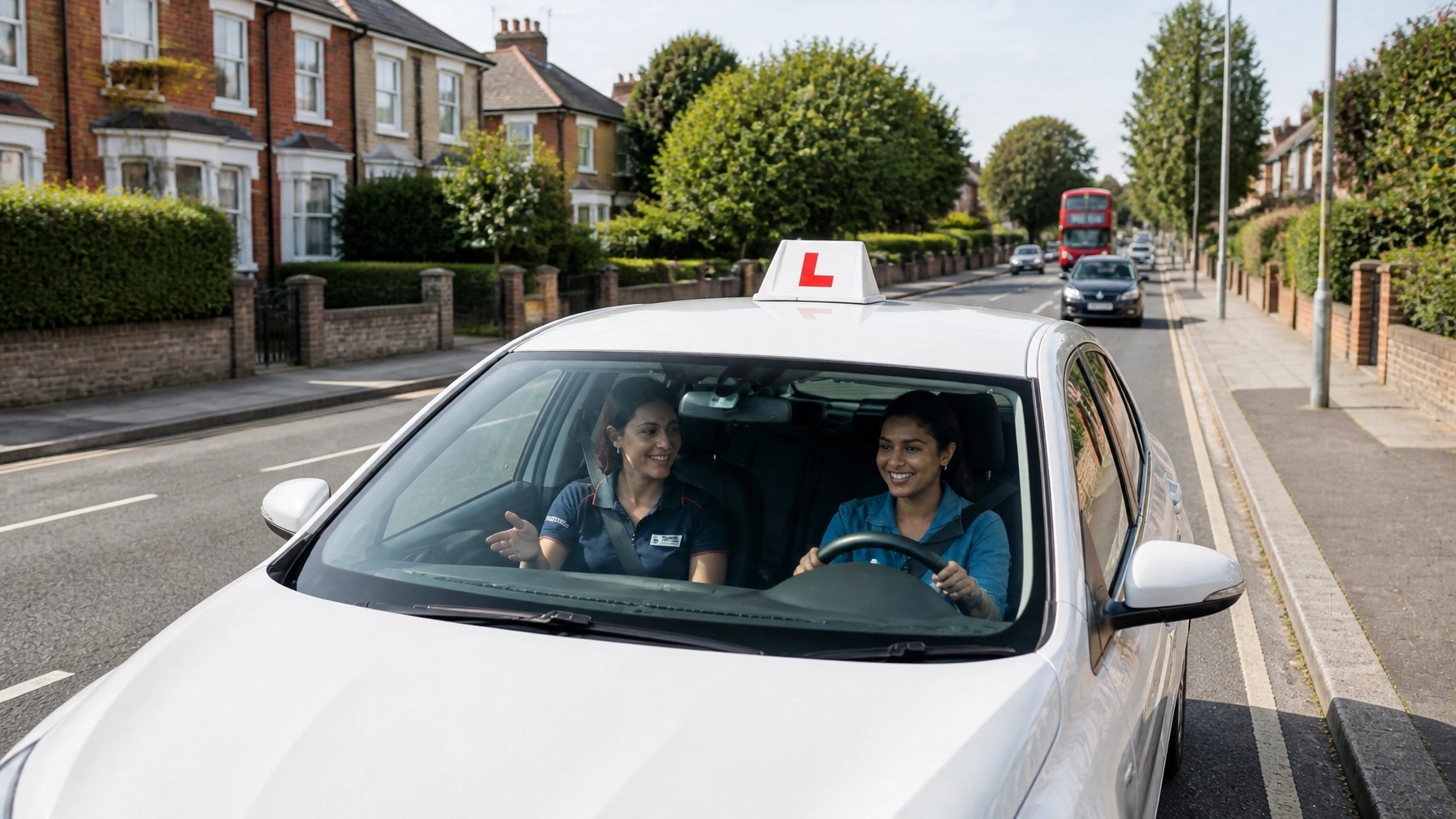
Alt tag: A UK right-hand-drive driving school car with the steering wheel on the right, travelling on the left side of the road through a residential street with L-plates clearly visible.
6. The Price vs. Value Balance
We know, being a student or a young professional is expensive! It’s tempting to go for the cheapest hourly rate you can find. However, cheaper isn't always better.
If an instructor charges £5 less per hour but takes 20 more lessons to get you test-ready, you’ve actually spent more money in the long run. Look for block booking discounts and schools that have a clear structure for their lessons. You can see a transparent breakdown of how much driving lessons cost to help you budget effectively.
7. A Pro-Tip for Bloggers: Link Building and Community
If you’re a local blogger or a business owner reading this, you might wonder how you can help others find the right school. This is where "backlinks" come in! If you find a local service: like a driving school: that provides amazing value, linking to them in your own blog posts is a fantastic way to build a community.
Practical backlink strategies include:
- Guest Posting: Writing a piece for a local community site about your learning experience.
- Local Directories: Ensuring reputable schools are listed on "best of" local lists.
- Resource Pages: Adding a "Useful Links for Students" section to your own website.
Helping people find quality education makes the roads safer for everyone!

Alt tag: An instructor inside a UK right-hand-drive lesson car, with the steering wheel on the right, using a tablet to explain a roundabout to a student in a clear UK driving lesson setting.
Wrapping Up
Finding the right school shouldn't feel like a chore. It’s the first step toward a lifetime of road trips, late-night drive-thrus, and the independence you’ve been dreaming of. Take your time, read the reviews, and don't be afraid to ask questions.
We’d love to help you get started on your journey. If you’re ready to take the plunge, we offer professional and friendly driving lessons in Burton-on-Trent that are tailored to your specific needs.
Good luck, and we’ll see you on the road!

Alt tag: A set of car keys beside a UK provisional driving licence in a learner-driver setup, styled for a UK right-hand-drive context with cues appropriate to vehicles with the steering wheel on the right and left-side driving.

Leave a Reply